National
100-Foot Currency Garland Sparks Viral Frenzy in Rajasthan’s Deeg: Tradition or Extravagance?


JAIPUR/DEEG: In a state known for its larger-than-life wedding celebrations, a recent ceremony in Rajasthan’s Deeg district has set a new benchmark for “monetary scale.” A 20-second video that has effectively “broken the internet” shows a groom scaling a ladder to don a massive, 100-foot-long garland made entirely of currency notes. While social media users are debating the ethics of such a display, local residents and authorities are pointing toward a unique regional custom.
The incident, which took place in Bamanwadi village under the Jurahara police station limits, has become the talk of the Mewat region. The sheer scale of the display—featuring currency notes of ₹500 and ₹100 denominations—required several people on the ground to balance and support the weight of the garland as the groom ascended.
The viral footage captures the moment the groom, identified as Ruknuddin Meo, climbed a ladder placed against a building to accommodate the vertical length of the garland. His nephew, Ansar Meo, who was also a groom at the joint ceremony held on April 19, shared the spotlight.
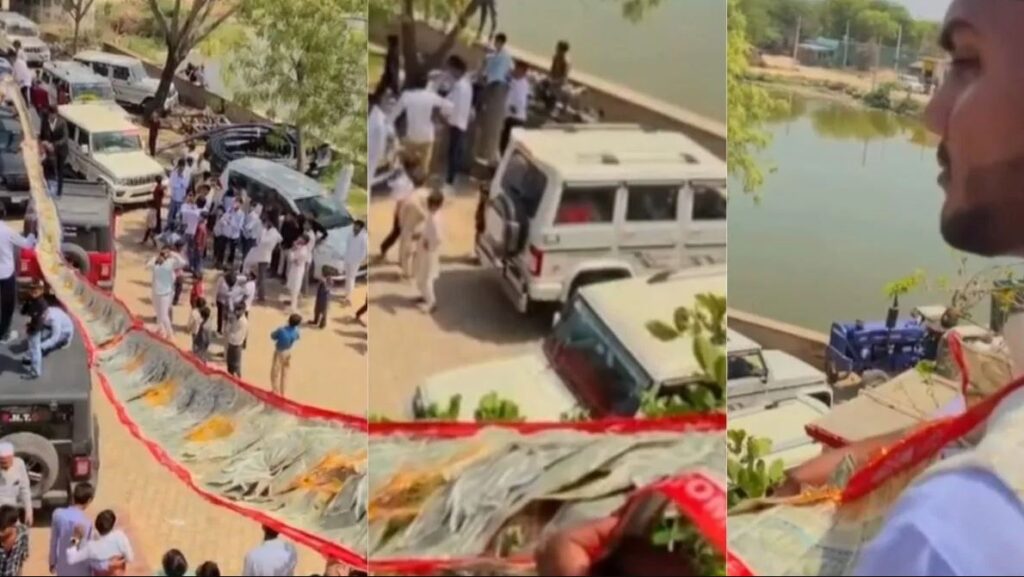
The visual of a man climbing a ladder just to put on a garland has drawn both awe and criticism. Below the ladder, the presence of parked jeeps and a large crowd highlighted the theatrical nature of the event. Estimates suggest the garland contained thousands of notes, though the exact total value remains a subject of local speculation.
As the video drew national attention, the Rajasthan Police initiated a preliminary inquiry to ensure no illegal activities, such as money laundering or the use of counterfeit currency, were involved.
Sharan Gopinath Kamble, Superintendent of Police (SP), Deeg, clarified the situation today. “Preliminary inquiry suggests that the garland was hired. Such garlands are available for rent in Nuh, Haryana, specifically for display during wedding ceremonies. So far, no illegality has been found in the matter,” the SP stated.
This revelation—that the garland was a rented prop—has added a surprising twist to the narrative. In many parts of the Mewat region, spanning Rajasthan and Haryana, “hiring” currency garlands for display is a customary practice used to symbolize prosperity and celebrate the union of families, without the family necessarily owning the cash displayed.
Village Sarpanch Abdul Mazeed defended the ceremony, noting that such practices are part of local tradition. “The people who rent out such garlands brought them here for display. There was only one garland used by both grooms. It is a way to make the wedding memorable for the community,” he said.
This tradition of renting currency-based decorations is a growing trend in Nuh and surrounding areas. Professional decorators assemble these garlands using genuine currency (often pinned or stapled in a way that doesn’t damage the notes) and rent them out for a fee, ranging from a few thousand to several lakhs of rupees, depending on the “face value” of the garland.
Despite the “tradition” tag, the incident has reignited a debate regarding the Reserve Bank of India (RBI) guidelines on the mishandling of currency notes. The RBI has long appealed to the public not to use currency notes for making garlands, as stapling, pinning, or heavy handling can shorten the life of the banknotes and deface the national currency.