National
ISRO Expands Scientific Partnerships for Moon and Human Space Missions
ISRO Chairman V Narayanan has announced that the space agency is collaborating with the Department of Atomic Energy to develop an advanced artificial heating system that will enable future lunar landers to withstand the Moon’s extreme temperatures for up to 200 days, significantly enhancing India’s long-duration lunar exploration capabilities.

The Indian Space Research Organisation (ISRO) is working with the Department of Atomic Energy (DAE) to develop an advanced artificial heating system that could enable future lunar landers to survive the Moon’s harsh environment for extended periods.
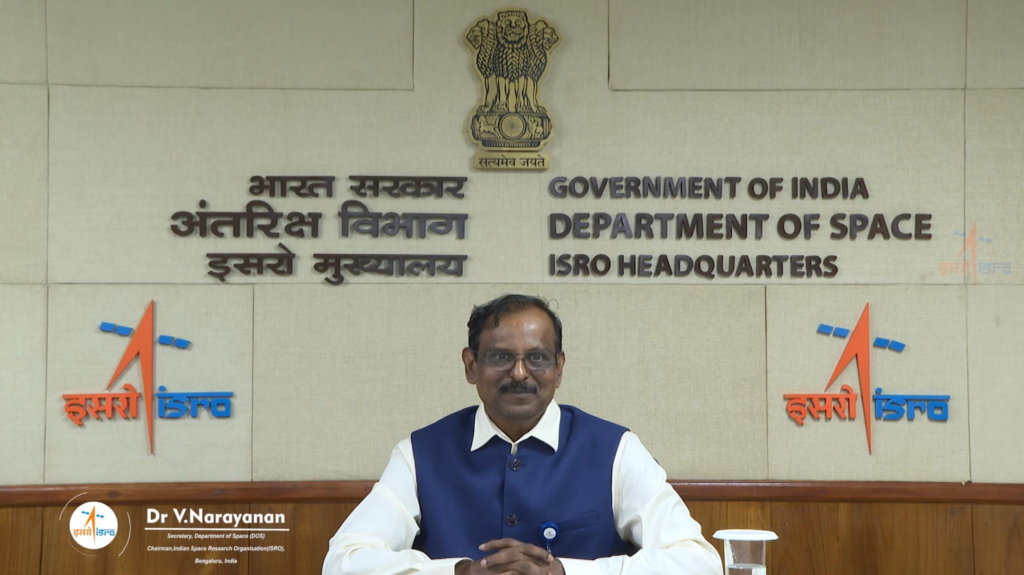
Addressing the CSIR-RISE Conclave in Bengaluru, ISRO Chairman V Narayanan said the new technology aims to overcome one of the biggest challenges in lunar exploration — surviving the extremely cold lunar nights.
Extending Lunar Missions
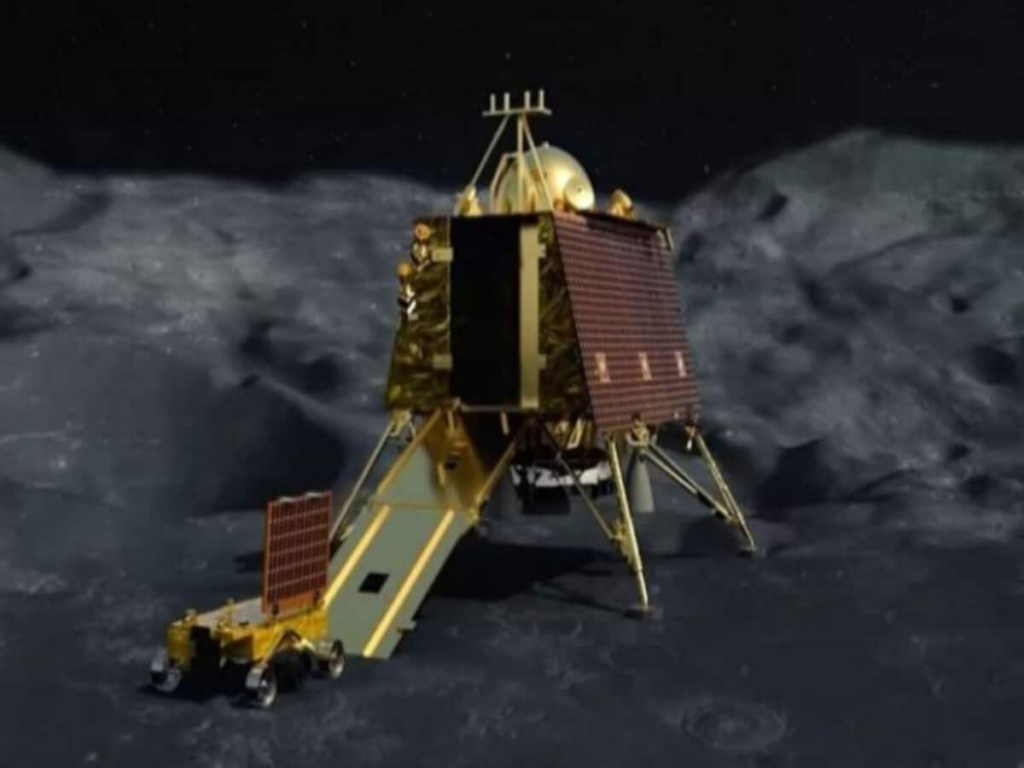
Narayanan explained that the Vikram lander of the Chandrayaan-3 mission, powered primarily by solar energy, remained operational on the Moon for about 14 Earth days, corresponding to one lunar daytime cycle.

However, future missions are expected to significantly surpass this duration.
“ISRO will now work with the Department of Atomic Energy to develop a lunar lander that can survive on the Moon for up to 200 days,” he said.
The proposed lander will be equipped with artificial heaters, enabling it to function through the Moon’s prolonged nights and withstand extreme temperature fluctuations.
Battling Extreme Lunar Conditions
The Moon experiences severe temperature variations because a lunar day and night each last approximately 14 Earth days.

During lunar daytime:
- Temperatures can rise to around 121 degrees Celsius.
During lunar nighttime:
- Temperatures can plunge to nearly minus 129 degrees Celsius.
These conditions present significant engineering challenges, particularly for spacecraft dependent solely on solar power.
The development of artificial heating systems is expected to provide thermal protection to critical onboard systems and instruments, thereby extending mission lifespans.

Boost for Long-Duration Lunar Exploration
According to Narayanan, the new technology will pave the way for long-duration lunar exploration missions, allowing scientists to conduct extended scientific observations and experiments on the Moon’s surface.
Such advancements could prove crucial for future robotic missions and eventual human exploration initiatives.
Expanding Research Collaborations
The ISRO Chairman also highlighted the growing cooperation between the country’s leading scientific institutions.
He revealed that ISRO and the Council of Scientific and Industrial Research (CSIR) have jointly identified 40 areas of technological collaboration, with 17 projects already approved for implementation in the first phase.
The partnerships span multiple domains aimed at strengthening India’s indigenous technological capabilities.
Support for Gaganyaan and Space Medicine
Narayanan further stated that ISRO has forged similar collaborations with:
- The Department of Science and Technology (DST),
- Private sector partners,
- The Department of Biotechnology (DBT).
These collaborations are contributing to the development of space medicines and biomedical technologies required for the Gaganyaan human spaceflight mission.
Microgravity Research
ISRO has also worked closely with the Department of Biotechnology on microgravity experiments conducted during the Axiom-4 mission to the International Space Station (ISS).
These experiments were carried out by Group Captain Subhanshu Shukla, generating valuable scientific data that could support future human space missions.
Advancing India’s Space Ambitions
The proposed lunar heating system represents another major step in India’s expanding space programme following the success of Chandrayaan-3, which made India the first country to achieve a soft landing near the Moon’s south polar region.
By combining expertise from multiple scientific disciplines, ISRO aims to strengthen the country’s capabilities in lunar science, human spaceflight, and next-generation space technologies.