Kolkata
Governor Dissolves Assembly; Mamata Banerjee Ousted as Chief Minister

In a move that has sent shockwaves through the Indian political landscape, West Bengal has been plunged into an unprecedented constitutional crisis. On Thursday evening, Governor RN Ravi exercised his supreme constitutional authority to dissolve the West Bengal Legislative Assembly, effectively terminating the tenure of Mamata Banerjee as the Chief Minister.
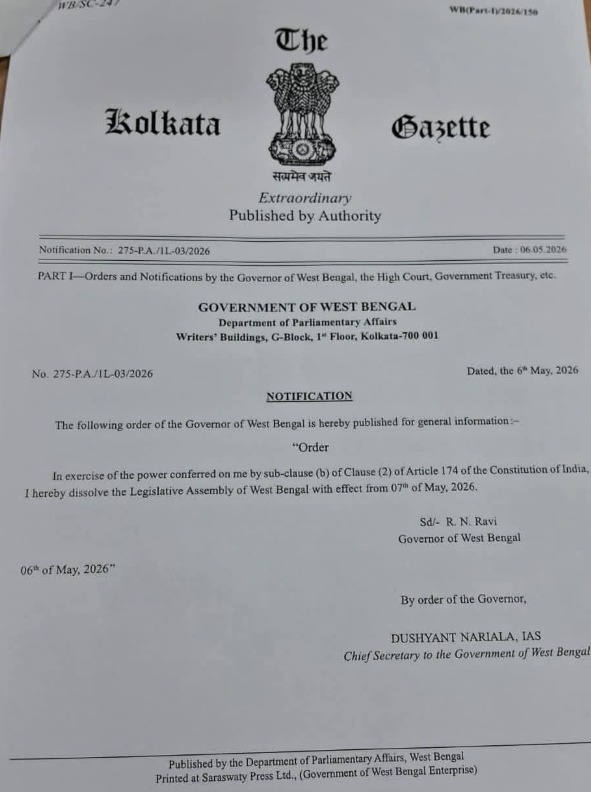
The notification, issued from Raj Bhavan, marks the climax of a bitter, week-long standoff between the Trinamool Congress (TMC) leadership and the Governor’s office following a volatile election cycle. The dissolution, invoked under Clause 2 of Article 174 of the Constitution of India, brings an abrupt end to the TMC’s decade-plus governance in the state and paves the way for a period of intense political uncertainty.
The Governor’s Proclamation
The official statement released by the Governor’s secretariat was brief but definitive. “I hereby dissolve the Legislative Assembly of West Bengal with effect from 7th May, 2026,” the notice signed by Governor RN Ravi read.
By invoking Article 174(2)(b), the Governor has moved to break a deadlock that had paralyzed the state administration since the declaration of the recent Assembly election results. While the Governor’s role is typically ceremonial, acting on the advice of the Council of Ministers, constitutional experts suggest that this “nuclear option” was exercised amidst a breakdown of constitutional machinery, where the incumbent Chief Minister reportedly refused to vacate office despite losing the confidence of the house or failing to recognize the electoral mandate.

A Defiant Exit: Mamata Banerjee’s Stand
The dissolution comes after days of high-octane drama at Nabanna, the state secretariat. Mamata Banerjee, the firebrand leader who has dominated Bengal’s politics since 2011, remained steadfast in her refusal to resign. Sources close to the TMC leadership indicated that Banerjee viewed the Governor’s actions not as a constitutional necessity, but as a “political vendetta” orchestrated by the Centre.
In a series of defiant statements leading up to the dissolution, Banerjee leveled grave allegations against the Bharatiya Janata Party (BJP) and the Election Commission of India (ECI). She claimed that the BJP’s “decisive debut” and subsequent gains in the eastern state were not a reflection of the people’s will, but rather the result of a “systemic looting of votes” and widespread “EVM tampering.”
“This is a dark day for democracy,” a TMC spokesperson stated shortly after the Governor’s announcement. “The mandate was stolen through collusion between the saffron side and the Election Commission. Our Chief Minister refused to bow down to an immoral victory achieved through the manipulation of machines rather than the hearts of people.”
Banerjee’s refusal to step down had created a unique legal vacuum in the state, with the BJP—which claims to have secured a moral and numerical victory—demanding her immediate ouster. By dissolving the cabinet, the Governor has effectively stripped the TMC of its executive power, likely leading to the imposition of President’s Rule or the appointment of a caretaker government until fresh elections can be held.
The Ground Reality: A State in Flux
The atmosphere in Kolkata and across the districts remains electric. Supporters of the Trinamool Congress have taken to the streets in several pockets, alleging a “constitutional coup.” Meanwhile, BJP workers have begun celebrations in other parts of the state, hailing the Governor’s move as a “restoration of democracy.”
The BJP, which has seen a meteoric rise in its influence in West Bengal over the last decade, maintains that the election results were a clear mandate for change. They have dismissed Banerjee’s allegations of EVM tampering as “the desperate excuses of a defeated leader.”

“The people of Bengal have spoken, and Mamata Banerjee’s refusal to accept that reality was an insult to the Constitution,” said a senior BJP leader in New Delhi. “The Governor has acted to uphold the law of the land. The era of TMC’s misrule has officially come to an end.”
Constitutional Implications
Legal scholars are currently debating the validity and the long-term impact of the Governor’s decision. Article 174 gives the Governor the power to summon, prorogue, and dissolve the house. However, such powers are usually exercised on the advice of the Chief Minister.
“If the Governor acts against the advice of the Chief Minister, or in the absence of it, it must be substantiated by a total collapse of the constitutional framework,” says a former Supreme Court judge. “If the Chief Minister was indeed refusing to resign despite losing her majority or obstructing the formation of a new government, the Governor’s discretionary powers come into play to prevent an administrative vacuum.”
The case is almost certain to be challenged in the Calcutta High Court or the Supreme Court of India in the coming days, as the TMC seeks to stay the dissolution and regain control of the administration.
What Lies Ahead for Bengal?
As of Thursday night, the state cabinet stands dissolved. For the people of West Bengal, the immediate future is marked by administrative flux. With the Assembly gone, all eyes are now on the Union Home Ministry and the President of India.
The dissolution effectively resets the political clock. It remains to be seen whether the Governor will invite the BJP—as the largest party or coalition—to form a caretaker government, or if the state will be placed under a period of President’s Rule to allow the dust to settle before a re-election is called.
For Mamata Banerjee, this is perhaps the greatest challenge of her political career. Known as the “Street Fighter of Bengal,” she now finds herself outside the corridors of power, fighting a battle that is as much legal as it is political. Her narrative of “immoral defeat” and “EVM fraud” will likely be the centerpiece of her campaign as she attempts to mobilize her grassroots base for the inevitable electoral battle that lies ahead.
The coming weeks will determine whether this dissolution is a temporary pause in Bengal’s chaotic democracy or the beginning of a fundamental shift in the state’s political identity. For now, the “Didi” era in the Chief Minister’s office has reached a sudden, jarring halt.